Thinking about a new fence but not sure what it’ll really cost? You’re not alone. For many Savannah homeowners, a Vinyl Fence hits that sweet spot: clean look, minimal upkeep, and serious staying power in our heat and humidity. But costs vary, and it helps to know why. Here’s a friendly, straight-shooting guide from your neighbors at Savannah Gate & Fence to help you plan with confidence—no surprises, just clear numbers and local know-how.
Contents
- 1 What actually drives the price of a vinyl fence?
- 2 So… how much are we talking in Savannah?
- 3 Privacy, picket, or semi-privacy—what fits your street and your wallet?
- 4 Colors, accents, and little extras that nudge your budget
- 5 Install methods in coastal soil: why the footing depth matters
- 6 Permits, utilities, and HOA rules around Savannah
- 7 Maintenance and life-cycle costs: the long view
- 8 DIY or hire a pro? The honest trade-offs
- 9 When to schedule in Savannah—and why timing saves money
- 10 How Savannah Gate & Fence builds a clear, fair estimate
- 11 Back-of-napkin math: a quick way to budget
- 12 Local realities that make vinyl worth it here
- 13 What about brands and specs? A quick cheat sheet
- 14 Ready to talk numbers with a local team that keeps it easy?
What actually drives the price of a vinyl fence?
Here’s the thing: you can have two yards with the same footage and end up with very different totals. That’s not a trick—it’s the mix of style, materials, terrain, and a few sneaky extras that swing the price needle.
- Fence style and height. Picket and ranch-rail cost less; full 6-foot privacy panels cost more because there’s more material and heavier posts.
- Linear footage. The longer the fence line, the more posts, panels, and labor. Simple math—but corners and gate placements can nudge it up or down.
- Material grade. Thicker vinyl that meets ASTM F964 standards, UV-stabilized with titanium dioxide, costs more up front but lasts longer and resists sag and chalking.
- Gates. Each gate adds posts, hardware, and time. A single walk gate is modest; a double drive gate jumps more.
- Terrain and soil. Soft coastal soils, roots from live oaks, or sloped ground add effort. Rackable panels and deeper footings may be needed for wind and grade.
- Old fence removal. Hauling away tired wood or Chain Link adds a small per-foot fee.
- Permits and HOA. City rules, sight triangles on corner lots, or HOA style guidelines can affect height, layout, and schedule.
- Season and schedule. Spring rush can book crews weeks out; summer storms can slow a day or two. Labor supply and lead times matter.
You know what? The biggest lever you control is the style and height. From there, it’s details and local conditions.
So… how much are we talking in Savannah?
Prices change with materials and fuel, but these are realistic local ranges for vinyl fence installation Savannah homeowners ask us about all the time. These numbers reflect typical projects within Chatham County and nearby coastal areas.
| Style | Material per linear foot | Installed per linear foot |
|---|---|---|
| 4 ft picket or ranch-rail | $14–$28 | $26–$42 |
| 6 ft semi-privacy | $18–$32 | $30–$48 |
| 6 ft full privacy | $22–$40 | $34–$58 |
Color upgrades (tan, gray) commonly add 10–15 percent. Woodgrain textures can add 25–35 percent. Decorative lattice tops or accent rails typically add $8–$15 per foot installed.
Let’s ground this with quick scenarios:
- Small yard, picket look, 120 ft. One walk gate, flat yard. Ballpark: $3,300–$4,700 installed.
- Average backyard, 6 ft privacy, 170 ft. Two walk gates, a few tree roots. Ballpark: $6,100–$9,300 installed.
- Corner lot, 220 ft mixed height. Front picket for curb appeal, rear privacy, one drive gate. Ballpark: $8,400–$12,800 installed.
Every property’s different, but that gives you a fair window. We’ll refine it on-site once we see the grade, setbacks, and gate needs.
Privacy, picket, or semi-privacy—what fits your street and your wallet?
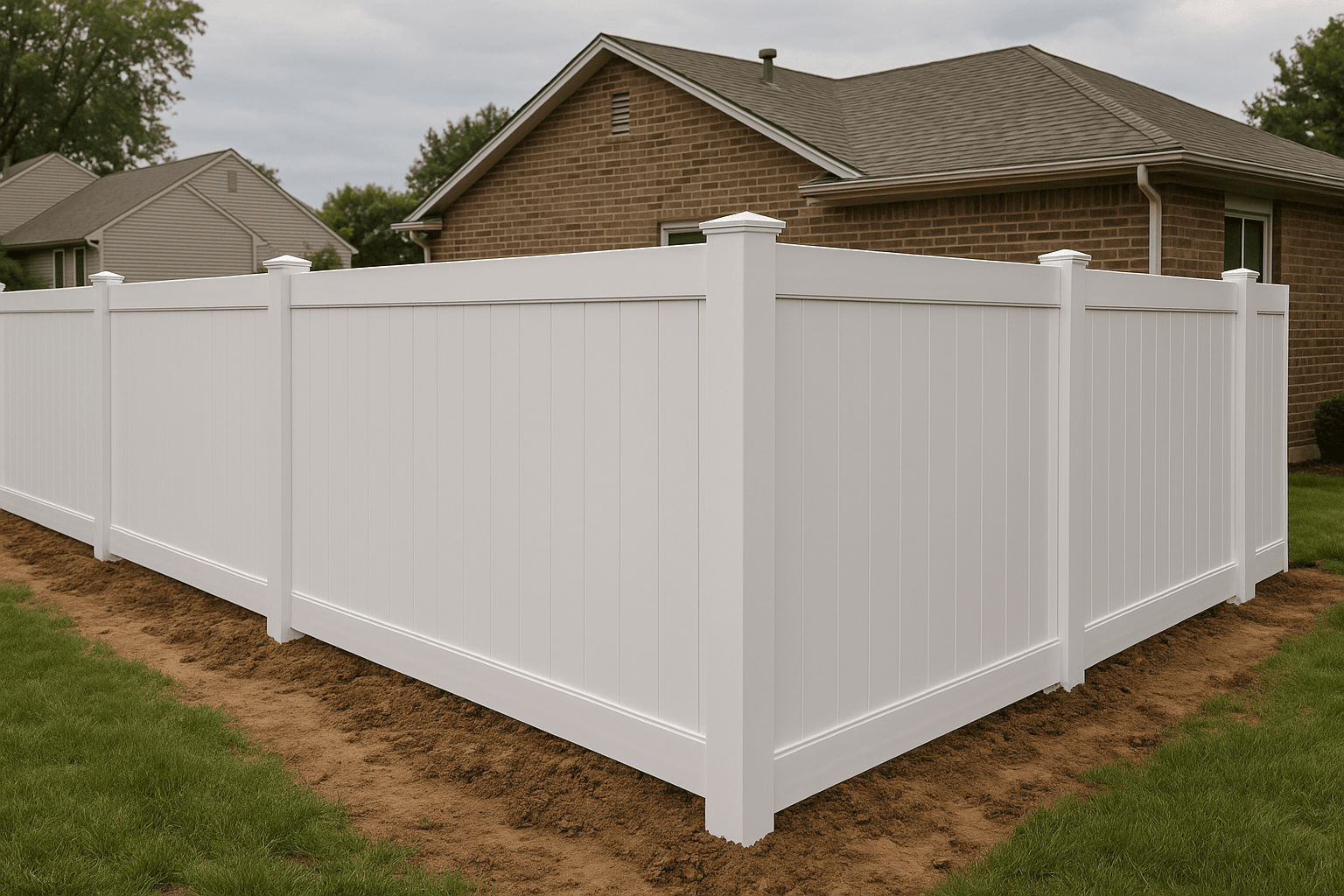
There’s no wrong answer, just the right balance for your home. A classic white picket feels “Savannah front porch.” A tall Privacy Fence tucks your backyard away from traffic or curious pups. Semi-privacy splits the difference, letting in light yet still screening views.
One small contradiction that matters: privacy panels block wind well—sometimes too well. In stormy weather, that wind load pushes on posts. That’s why we size footings properly and use reinforced rails where needed. With picket or semi-privacy, wind passes through, which can let you save a bit on reinforcement while still getting style points.
Colors, accents, and little extras that nudge your budget
White vinyl is the budget-friendly champ and still the most popular. Tan, khaki, and gray feel modern and hide pollen a touch better in spring. Woodgrain looks like stained cedar from a distance, but it’s specialty and carries a premium.
- Color choice. White is most affordable; neutrals +10–15 percent; woodgrains +25–35 percent.
- Decorative tops. Lattice, picket scallops, or closed top accents typically add $8–$15 per foot.
- Caps and trims. New England caps, Gothic tops, or external caps vary from $6–$20 per post installed.
- Reinforcement. Aluminum or galvanized inserts in rails and gate frames resist sag—well worth it in coastal wind.
- Gates. Walk gates often land $250–$600 each; double gates $500–$1,200 depending on width and hardware.
- Driveway automation. If you’re pairing a vinyl drive gate with an operator, budget $1,800–$4,500+ including power and safety devices.
Small touches matter. Stainless or powder-coated hardware handles our salty breeze better than basic zinc. It’s a tiny bump in cost for a big bump in longevity.
Install methods in coastal soil: why the footing depth matters
Our sandy-clay soils drain fast, then hold water after heavy rain—strange but true. Add summer thunderstorms and the occasional tropical system, and posts need a strong footing plan.
We typically set vinyl posts in concrete, bell the bottom of the hole for uplift resistance, and target 24–30 inch depths depending on fence height and wind exposure. No-dig spikes can work for lightweight ranch-rail, but for 6 ft privacy near open areas, concrete wins for stability. Expanding foam backfill is neat and clean for some installs, yet we still prefer concrete for privacy sections in open wind corridors.
Labor is the hidden hero. Straight lines, consistent heights, and clean rack around a slope make the fence look right. We use string lines, levels, and rackable panels designed to follow grade. It’s part art, part craft.
Permits, utilities, and HOA rules around Savannah
Most Residential fences in the City of Savannah require a simple permit, and some neighborhoods have height limits near sidewalks or alleys. Corner lots usually need a “sight triangle” at intersections, which can affect height for a few feet. HOAs may specify style and color for street-facing runs. None of this is scary—we navigate it daily.
- Permits. Expect a modest permit fee and a sketch or survey. We help prepare the submittal.
- Property lines. A recent survey is gold. If you don’t have one, we can refer a local surveyor.
- Utilities. Call Georgia 811 before we dig. It’s free and required. We’ll coordinate the locate.
- Setbacks. Vary by zoning. We’ll keep the fence inside your line and meet the city’s clearance rules.
One more local quirk: alleys and historic lanes. If your property backs one, there can be access or height constraints. We’ll flag that during your site visit so costs and timing stay predictable.
Maintenance and life-cycle costs: the long view
People say vinyl is “no maintenance.” Not exactly—but it’s close. You’ll wash it, not repaint it. In our shade and humidity, a soft brush and a bucket with mild soap or a 1:10 bleach solution clear mildew fast. A low-pressure rinse (think garden hose or a wide-fan setting) keeps the surface happy. If you love gadgets, a pressure washer on a gentle tip works—just keep your distance.
Over 20–30+ years, vinyl usually beats wood on total cost. No stain, no rot, no warped pickets after a wet summer. Panels are replaceable if a tree limb wins a round. And good vinyl—brands like Bufftech by CertainTeed, ActiveYards, Freedom, or Illusions—uses UV inhibitors to prevent yellowing. Ask about the warranty; many carry limited lifetime on materials.
DIY or hire a pro? The honest trade-offs
Could you DIY? Absolutely—if you enjoy layout, digging holes in our rooty soil, and fussing with lines until they’re razor straight. Materials alone can shave 20–35 percent off the bill if you already own tools and have the time. But factor tool rental (auger, saws), concrete delivery, debris disposal, and your weekends. A wavy line or a sagging gate costs more to fix later than to set right the first time.
Pros bring speed, warranty, and the muscle memory that keeps rails square and gates smooth. We also spot underground sprinklers, French drains, or invisible dog fences before they become “surprises.” If you want a couple of sweat-equity days without full commitment, some homeowners handle clearing brush or removing an old fence and let us do posts and panels. We’re flexible.
When to schedule in Savannah—and why timing saves money
Spring is busy because everyone’s outdoors again. Material lead times tighten, and crews book fast. Summer heat slows digging after lunch, and afternoon storms can bump a day. Fall is surprisingly great: cooler ground, steady schedules. Winter? We work year-round here—freezing ground isn’t our issue—but heavy rains can delay pours by a day.
If you’re timing your install for pool season or a backyard wedding, nudge the calendar up a month. It eases permit timing and gives us a weather buffer.
How Savannah Gate & Fence builds a clear, fair estimate
We keep it simple and transparent. First, we listen: privacy needs, pets, pool code, curb appeal. Then we measure, check setbacks, and sketch the layout with gate locations and heights. If we spot wind exposure or tricky grade, we recommend post depths and reinforcements right there—no mystery add-ons later.
You’ll get a clear line-item proposal showing linear footage, style, color, gates, hardware, removal if needed, permit help, and cleanup. We source from trusted names with strong warranties, install to ASTM F964 where applicable, and use stainless or heavy-coated hardware that holds up near the coast. The install crew you meet at the start is the crew that finishes. And yes, we tidy up like it’s our own yard.
Back-of-napkin math: a quick way to budget
Let me explain a simple method you can try this afternoon:
- Measure your fence line. Walk the perimeter with a tape or a wheel. Round to the nearest 10 feet.
- Pick a style. Say 6 ft privacy. Use $40–$55 per foot installed as a planning range.
- Add gates. Walk gate: +$400. Double gate: +$800 to $1,200.
- Adjust for terrain and removal. Add 5–15 percent if sloped or rooty; $2–$5 per foot to remove old fence.
- Color/accents. Add 10–15 percent for tan/gray; +$10/ft for lattice.
Example: 160 feet of 6 ft privacy, one walk gate, white, mostly flat. 160 × $45 = $7,200. Add $400 for the gate. If you’re removing 120 feet of wood at $3/ft, add $360. Budget: about $7,960 plus permit. That’s a solid, conservative placeholder until we walk the site.
Local realities that make vinyl worth it here
We live under live oaks with Spanish moss, we get sideways rain, and the summer sun means business. Vinyl shrugs off rot, termites, and splinters. It doesn’t mind sprinkler overspray. It does like a rinse now and then, especially on the shady north side where mildew can show. That small chore keeps it crisp for years.
Another Savannah quirk: alley access and narrow side yards. Vinyl panels come in standard widths, but we can cut, step, or rack them to thread the needle between AC units, utilities, and that one camellia bush you love. It’s the kind of problem-solving we geek out on—so your fence looks planned, not forced.
What about brands and specs? A quick cheat sheet
Curious whether a product is “the good stuff”? Look for:
- ASTM F964 compliance. Sets minimums for impact resistance, weathering, and dimensions.
- UV inhibitors. Titanium dioxide content fights yellowing and brittleness.
- Reinforced rails and gate uprights. Especially for 6 ft privacy and larger gates.
- Hardware quality. Stainless or premium coated fasteners and hinges for coastal air.
- Warranty. Limited lifetime on materials from reputable brands like Bufftech, ActiveYards, Freedom, or Illusions.
If a quote seems unusually cheap, it may be thinner vinyl, fewer reinforcements, or light-duty hardware. That can look fine day one but struggle by year five. We’d rather do it right the first time.
Ready to talk numbers with a local team that keeps it easy?
Whether you want crisp white picket up front or sturdy 6 ft privacy in back, Savannah Gate & Fence builds it to last—and we price it clearly so you can plan. Tell us about your yard, your pets, and your style. We’ll bring tape measures, smart layout ideas, and a no-pressure, line-by-line estimate.
Call us today at 912-800-0818 or tap Request a Free Quote. We’ll help you choose the right vinyl fence costs plan for your home and set a schedule that fits. Friendly, local, and built the right way—so your fence looks good not just this summer, but for many to come.